1
Imhotep was a semi-legendary hero and god who was later identified with
Asclepios (or Aesculapius). Imhotep was not only the inventor of the arts
of architecture and metallurgy, but also of the art of writing (cursive?),
city-planning, astrology, magic, divination and so on. Imhotep was, allegedly,
the son of Ptah, the god of Punt, the Land of the Gods. And Punt was no
other than Indonesia, as we already said. So, Imhotep was indeed a Hindu
from Indonesia, the name we now give to Punt.
1
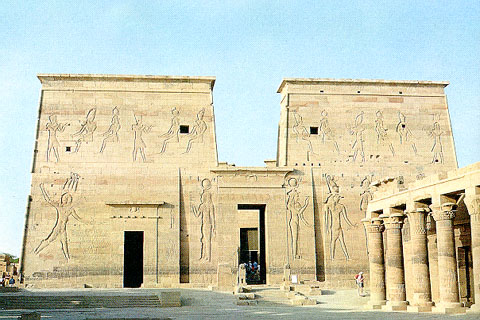
Imhotep was a semi-legendary hero and god who was later identified with
Asclepios (or Aesculapius). Imhotep was not only the inventor of the arts
of architecture and metallurgy, but also of the art of writing (cursive?),
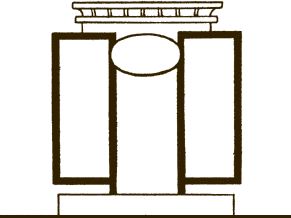
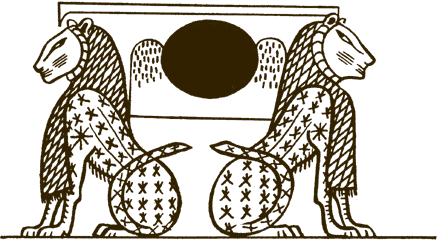
city-planning, astrology, magic, divination and so on. Imhotep was, allegedly,
the son of Ptah, the god of Punt, the Land of the Gods. And Punt was no
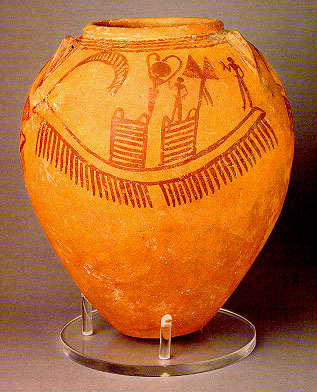
other than Indonesia, as we already said. So, Imhotep was indeed a Hindu
from Indonesia, the name we now give to Punt.
Imhotep-Asclepios was often
identified or associated with serpents, an emblem of his Naga nature, the
Nagas being the white Serpent People (or Dragons) of India and Indonesia.
The mysterious figure of Imhotep evokes the no less enigmatic than the
one of Hiram Abiff, the builder of Solomon's Temple. Solomon imported Hiram
and his gangs of workers and artificers from the equally legendary Tyre (the Primordial Phoenicia that is the same
as Ophir or Punt).
Perhaps both Imhotep and
Hiram Abiff, the legendary founder of the Free-Masons, were indeed the
personifications of the crews of specialists imported from the Indies in
the primordials of civilization. They are also related to the Oannés
(i.e., Nagas) that civilized Mesopotamia (Sumer) and taught them all arts.
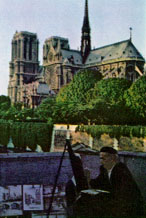
Perhaps even the Goths who build the Gothic cathedrals belong to the same
confrary of Indian experts in guilded crafts such as stone masonry, smithing
metals, and so on.
Back
2
In reality, this sacred ritual is of Hindu origin, as discussed by M. Eliade
and by A. Coomaraswamy, and is routinely used in the construction of Hindu temples.
The stake is driven into the head of the subterranean Naga (Shesha) that
supports the earth from below, and who is the alias of Atlas, the anguipedal
Titan. The circle with the crossed diameters is, in reality, an image of
the earth, usually thus represented in antiquity.
More esoterically, the Crossed
Circle is a symbol of Atlantis, which had precisely this shape, as described
by Plato. Atlantis imaged Lanka, indeed placed at the Center of the World,
at the intersection of the line of the Equator and that of Meridian Zero.
This was the origin of geographical coordinates, which, in Hindu antiquity,
lay in Indonesia. The Crossed Circle was also adopted as the symbol of
Atlantis, as several Atlantologists of note such as Otto Muck have remarked.
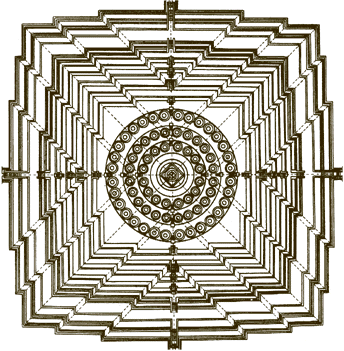
These two lines form the
figure of the Cross that is everywhere the symbol of Paradise and its Holy
Mountain (Meru, Calvary, Alborj, Kailasa, Qaf, etc.). As we argue elsewhere,
the Crossed Circle represents the Holy Mountain seen from above. And this
Holy Mountain is itself a "squared circle" representing a conical base
(circular) that tapers into a pyramid (square). We find the Holy Mountain
thus represented both in the Americas (Navajos, etc.) and in the Far East
(Burma). The Holy Mountain is also represented as a Cross, as seen from
above, in the famous Hindu Kalachakra Mandalas, a standard representation
of Paradise.
Back
3
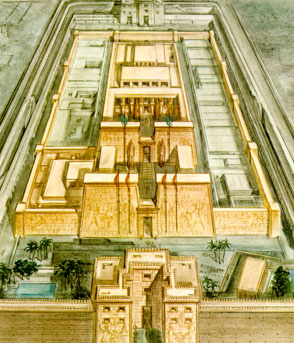
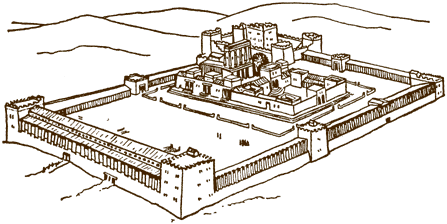
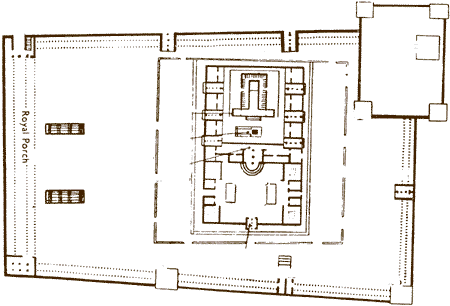
The Jewish temple was called hekal in Hebrew. The word is said to derive
from the Sumerian e-gal through the Akkadian ekallu, meaning "big house".
More likely, the Hebrew word and its Sumerian archetype derive from the
Dravida e-kal meaning "lofty pillar". The radix e (or he or che) means
"lofty", "strait" and implies an idea of "scepter" and "command". The radix
kal (or chal) means "stone" and, by extension, a standing stone (menhir,
pillar, obelisk, betyl, etc.).
Hence, the Dravidian word
can be interpreted as meaning "big house", as in the Sumerian e-galu, a
name applied rather to the palace than to the temple. The Dravidian term
evokes the Hebrew ones applied to pillars (mazzeba, bethel). These also
embody the idea of "erect". More usually, the temples — particularly the
Egyptian and the Hindu ones — were characterized by the presence of a lofty
pillar (a pyramid, etc.) or even of a pair of such (obelisks, pylons, etc.).
Very often, the building itself (adytum) was comparatively small.
Back
4
The cubic structure evokes the one of the Celestial Jerusalem, likewise
cubic or pyramidal (Rev. 21:16). The square shape corresponds to the earth,
whereas the circle symbolizes the sky (the horizon). Temples usually represent
the "squaring of circle", the impossible union of incongruals represented
by Earth and Sky, Fire and Water, King and Slut, and so on. In essence
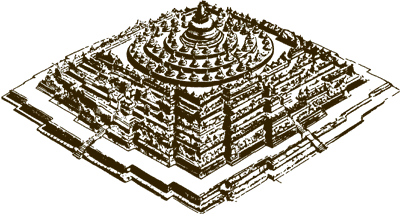
all such structures represent Mt. Meru is pyramidal in shape, but is also
often represented as a cone. Many temples and pagodas often ingeniously
combine the square shape and the round one.
Back
5
Solomon sent Hiram and his men overseas to Ophir in order to fetch him
the cedarwood, the sandalwood and the fir (teak?) for the construction of
the Temple and of his palace (cf. I Ki. 5-10; II Chr.2, etc.). They departed
from the port of Ezion-Geber, in the Red Sea and, hence, could only go
southwards, to the Indies, and not north, towards the country now called
thus, in commemoration of the primordial Lebanon. The radix leb- (or
lev-, etc.) relates to "lion" . Above all, it alludes to Lanka, the legendary
Island of the Lions so often equated with Atlantis, Avalon and other such
Paradises.
The word "Lebanon" ultimately
derives from the Dravida Lev-annon meaning "Ancestral Lanka" or "Ancestral
Island of the Lions" in Dravida. Besides, the modern Lebanon never produced
fir and, far less, sandalwood (algum or almug = valguka = "sandalwood",
in Dravida). The palace of Solomon was also built of cedarwood, and was
indeed called "House of the Forest of Lebanon" (I Ki. 7:2). The Song of
Songs — so profane in its essence and so clearly copied from Hindu and
from Egyptian counterparts — also speaks of this legendary "Lebanon" as
of Paradise (S. of S. 3:9; 4:8-16; 5:15; 7:4), etc..
Back
6 Indeed,
Ezekiel tells of two Eagles and two Trees of Life (one a cedar, and the
other a grapevine, as usual). This mysterious parable is the famous Hindu
one concerning the two birds and which dates from Vedic times in India.
It figures in the Rig Veda (1:164), in the hymn entitled The Riddle of
the Sacrifice. This is the most mysterious of all in the already enigmatic
Vedas. We discuss the mysterious parable of the two birds in our book on
Alchemy, and will not repeat this subject here.
The passage just mentioned
of Isaiah is telling of the return of the children of Israel to their formerly
destroyed but recovered Eden, where they will again rebuild the Celestial
Jerusalem. Eden is there equated to Tarshish and the Isles (those of Atlantis)
and the "ships of Tarshish" are identified to doves, an image often associated
to Atlantis (the Pleiades or Atlantides = peleias or "doves", in Greek).
Isaiah even tells of the replanting there of the Cedar of Lebanon and of
the reconstruction of Jerusalem, "the Zion of the Holy One of Israel" under
a new sun and a new moon (that is, in the antipodals).
Back
7
It may well be the case that word "sphinx" — which has no certain etym in
Egyptian — indeed derives from the proto-Dravida ech-pinx, meaning "the ghost
(i.e., the double or ka) of the dead" or, yet, "the guardian of the dead".
The Great Sphinx is mentioned in the famous stele attributed to Honitsen,
the daughter and lover of Kheops, as existing in the times of her famous father.
Moreover this stele also mentions the Great Pyramid as the tomb of Osiris. There are also other instances in ancient Egyptian records of the existence of the Great Pyramid before the times of Khufu (Kheops). Indeed, both this pharaoh and his whorish daughter are purely legendary, semi-divine characters who often figure in Egyptian tales as well as in those of other nations.
The name of the Sphinx is
usually derived from the Greek sphingein, meaning "to strangle". But this
may be indeed a corruption of the Greek shesep ankh ("the living image").
This is an epithet often applied to the sphinxes in Egypt. Hence, we see
that sphinxes were believed to be the guardians of the dead, just as the
Great Sphinx was the guardian of the Great Pyramid, the tomb of Osiris.
As her Egyptian name suggests, the Sphinx was the ka (or "double") of Osiris
guarding his own tomb against intruders.
Back
8
Amenti literally means "Occident", that is, "the Land of the Dead". The
word also alludes to the region where the sun mythically "dies" every day.
But this is only a rather transparent image. The sun or, rather, Ra, the
Sun-god, was a personification of the dead Atlantis. The Egyptians were
so centered on death and its cult, because they — in contrast to us — still
clearly remembered the Atlantean cataclysm. Likewise, Atlantis — the true
name of Punt or Amenti or Hades, etc. — also lay towards the southeast
of Egypt and of Greece, rather than towards the West and the Atlantic Ocean,
as so many authorities formerly thought.
The fact that the Egyptians
formally called the southeastern gate by the name of Eastern (or Oriental)
Gate is also full of esoteric symbolisms. Lanka and its counterparts (Amenti,
Punt, Ophir, Dilmun, Hades, Abzu, Yamakoti, etc.) were indeed located towards
the Orient in relation to the Mediterranean Basin. There, the Old World
civilizations arose and died. Lanka is old even in regards to India, and
it was there that its great epic, the Ramayana, was composed. In fact, Lanka
was the site of Paradise, the one we know under the name of Eden. Originally,
Lanka and its Holy Mountain (Trikuta, Meru, Atlas, Zion, Alborj, etc.)
were equated with the Mountain of the Orient, a term identical in meaning
with "Mountain of Origin", the birthplace of Mankind.
When it exploded, razing
Atlantis-Eden, the name of the Holy Mountain was naturally changed into
that of "Mountain of the Occident" (occidere = "to die"). Rather than to
directions — which vary with the position of the observer — such names
indeed refer to actual places. So, "Orient" designates the place where
the sun is born, and the new day starts by convention. And this was Indonesia,
the site of Lanka, the meridian of origin in antiquity. Likewise, "Occident",
the place where the sun died daily, referred to the western lands of Eurasia,
the Old World. The Egyptians, like the Greeks and other peoples, attempted
to transfer the myth to their new place of residence. But this never worked,
and only led to riddles and paradoxes that even today torment all sorts
of experts, unable to solve the puzzle created by this change of point
of reference.
Back
9
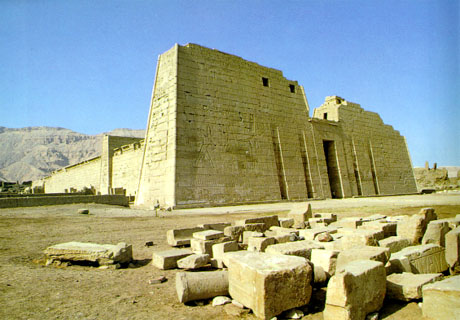
As such, these pylons represented the Gate of the Sun, another name of
the Mountain of the Orient (or of Sunrise), that is no other than Mt. Meru.
Such name indeed derives from Hindu epithets of Mt. Trikuta (or Meru).
For instance the name of Ophir — the mysterious region visited by Solomon's
men — indeed derives from the Dravida o-piru (or o-phiru) meaning "Gate
(o) of the Sun (piru)". Mt. Meru, the Mountain of the Orient, is also called
by epithets such as Hemadri ("Golden Mountain"); Karnikachala ("Lotus Mountain");
Devaparvata ("Mountain of God"); Trikuta ("Three Peaked"); Sunyodaya-giri
("Mountain of Sunrise"); Ushas ("Dawn" = the Malaya Range), Aruna-chala
("Mountain of Sunrise"), etc..
Back
10
We treat this fundamental matter in detail elsewhere. Despite its importance,
it cannot be treated here for reasons of space, and we recommend that the
interested reader seek our works on this subject. The "blooming lotus"
is, yet, an allegory of the explosion of Mt. Atlas. The symbolism of the
lotus (in both Egypt and India) is treated in other works of ours,which should be consulted by the more sanguine reader.
One of our works on the subject is entitled "The Secret of the Golden Lotus",
which also figures in our Homepage.
Back
11
The giant wielding the mace and striking down the Primordial Serpent is
an unequivocal reference to Atlantis and to the fact that it lay in Indonesia.
When one looks at a map of the region, the reason for the allegory becomes
evident. The figure represents quite accurately the local geography. The
raised arm and the mace correspond to the Malay Peninsula, locally called
Kra (or Kara = "Hand", "Arm", in Sanskrit).
The "head" of the giant is
the Southeast Asian promontory and the sacrificial victim he strikes and
cleaves in two formed by is the islands of Java and Sumatra, cleft apart
by the giant explosion of the Krakatoa volcano that opened the Strait of
Sunda (the "Door"). Far from being an illusion, this allegory is a sad
reality which is obsessively mentioned in the Bible (the raised, irate
"arm of Jahveh" smiting the impious) and in other mythologies.
Back
12
This triple-peaked crown, just as the Triple Mountain, can often assume
subtle variant shapes. One such is the three-stepped pyramid that is the
characteristic crown of Isis (herself a personification of the Great Mother,
Mu or Lemuria). Other variants of the triple crown are the two horns and
central disk of Hathor, the two horns and central peak of Reshet, the triple
lotus flowers (or papyrus stems) of Hapi, the trident crown of Iabet, the
triple-peaked mountain of Ha, the two arrows and shield of Neith, the triple
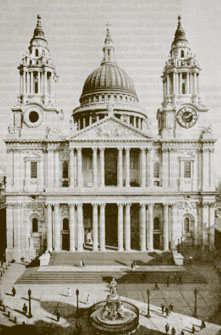
atef crown of Osiris, and so on. In the Christian churches and cathedrals,
the Triple Mountain usually assumes the shape of the double lateral spires
flanking the central, dwarfed tower. Its stunted size refers to the fact
that it exploded and collapsed, as explained further above.
Back
13
The cubit was, theoretically, the distance from the elbow to the tip of
the middle finger of an average sized adult. Its value varied, in the ancient
world, from about 18 to 21 inches (46 to 53 cm). The cubit is worth about
half a yard (36 inches) or half a meter, and it is not impossible that
the original measures of the Temple were given in yard or meters with the
inner sanctum measuring exactly 10 x 10 x 10 meters or yards. Such a double
unit standard of about 1 meter in length seems to have prevailed in the
ancient world, and it is likely that the meter unit was accurately known
from Atlantean times, as we argue elsewhere.
Back
14
Such emblems of deity are also frequently used in India and Tibet. Indeed,
the dollar sign $ — which we obtained from the Phoenicians — represents
the twin Pillars of Hercules around which is coiled the Serpent of Eden
or its equivalent, the banner or bandolier of the Hero. The ensign (or
banner or streamer) expresses the idea of "a visible sign", translated in Sanskrit
by names such as linga, ketu, dhvaja, etc.. The linga ( that is, the phallus of Shiva)
is the emblem of the Supreme God and, hence, of gods in general. It expresses,
as does the word ketu, the idea of Mt. Meru as the phallic mountain at
the center of the world. It also symbolizes the fall of the vajra, the
thunderbolt that destroyed Paradise (Jambudvipa). The linga was the archetype
of the concept of the netjer as a sort of omphalos (or raised stone) and,
more exactly, as an avatara of the deity fallen from heaven as a sort of
very special meteorite.
Jambu-dvipa ("Island of the
Jambu Tree") is the name of the innermost of the seven dvipas ("islands"
or "continents") that comprised the Cosmos in Hindu Cosmology. The dvipas
were circular and concentric, separated by circular oceanic strips. This
Hindu concept of the Cosmos is remarkably similar to Plato's conception
of Atlantis, and its sacred geometry was undoubtedly present at the back
of the philosopher's mind. The enormous jambu tree planted at the center
of Jambu-dvipa was the archetype of the Tree of Life everywhere.
In reality it was the volcanic
plume of Mt. Atlas (or Meru) which served both as a lighthouse and as an
ensign and a warning to all nations that grow impious and arrogant as Atlantis
did. We see, from the above comments, how the idea of representing the
idea of "godhead" by a banner or ensign undoubtedly passed from India (where
it makes sense) into Egypt (where it does not, at least to Egyptologists).
Back
15
The Strait of Sunda separates the island of Java from that of Sumatra.
It was opened by a gigantic prehistoric explosion of the Krakatoa volcano
that lies at the bottom of the strait. Such is the fact allegorized by
the myths of Hercules cleaving open the isthmus and opening a maritime
passage ("door") to the outer ocean. Obviously, such a thing did not happen
in Gibraltar, at least in the times of Man, in contrast with what indeed
took place in Indonesia.
This event, which is central
to the understanding of the true story of Atlantis is allegorized in a
multitude of myths from everywhere, as we explain in more detail elsewhere.
It is interesting to note that the portrait of pharaoh posted at the entrance
of Egyptian temples — shown in Fig. 2, for instance — as if smiting open
the door of the temple closely recalls the myth of Hercules opening up
the Strait of Gibraltar with the blows of his mace, as told in certain
Greek myths of the great hero, as we commented further above.
Back
16
Atlantis derives its name from that of Atala, the Primordial Phoenicia
(or "Land of the Palm Trees") of the Hindus. Atala literally means "the
Land of the Pillars" or "the Land of the Palms", the term tala, in Sanskrit,
meaning both a pillar or a palm-tree. Small wonder then that the Egyptians,
willing to represent Paradise, built their hypostyle temples with "palm-tree
pillars". Once again, the visual pun that does not make any sense in Egypt
can be traced back to India. More exactly, it can be traced back to Atlantis
and the Dravidas, for the wordplays with its name indeed derives from that
primordial language, ancestral of that of the ancient Egyptians.
The "pillars" in question
allude to both Atlas and Hercules, the two "Pillars of Heaven". However,
in the ancient myths the heroes and saints were said to become pillars
in Paradise, that is, in Atlantis. It is thus that Cu Chullain and his
braves turn into pillars in their final battle. Even in Judaism and Christianism,
the worthy are promised to become pillars in Paradise Restored (the New
Jerusalem). This fact can be seen, f. i., in Rev. 3:12; Gal. 2:9; 5; 3:6;
I Thim. 3:15, etc..
Back
17
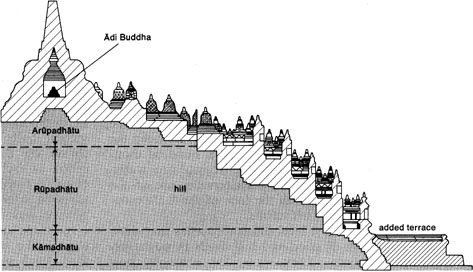
This type of agriculture is characteristic of mountainous regions and,
particularly of the Far East. The terraces are required not only to control
the water flow, but also to prevent erosion and to preserve the fertility
of the soil. The rain waters are collected at the summit of the mountains
and stored in dams called barays in Southeast Asia and Indonesia. This
word derives from the Dravida para-tt-is meaning a dam or cistern (para)
built upon a mountain or volcanic peak in order to provide water (is) for
agricultural purposes and, particularly, for the cultivation of rice in
terraced mountains.
It is from this Dravidian
base that the word "Paradise" (Sanskrit: Paradesha; Greek: Paradeisos;
Latin: Paradisus; Hebrew: Pardes; Zend: Pairidaesa, etc.) ultimately derives.
Even today it is possible to observe the terraced mountains used for cultivation
in India, in Indonesia, in Southeast Asia and, indeed, in the whole of
the Far East. The marvelous Hanging Gardens of Babylon, one of the Seven
Wonders of the Ancient World, were indeed a local recreation of Paradise
and its terraced orchards by Queen Semiramis.
Back
18
Adi Buddha is closely connected with the Tantric form of Buddhism called
Kalachakra (or "Wheel of Time") which arose in Bengal and spread to Tibet,
Java, Nepal and Mongolia. This form of Buddhism is also called Vajrayana
("the Way of the Vajra (or Thunderbolt)"). It is said to have originated
in Shambhalla, the mysterious underground realm of the King of the World
(Subterranean Atlantis?). Moreover, its doctrines are apocalyptic and center
on the return of the Saviour as Kalkin, the White Knight who is the 10th.
avatar of Vishnu.
This Primordial Buddha was
not accepted by the Southern Buddhists (of Shri Lanka) nor by those of
China and Japan. But he became dominant in Tibet, Mongolia and Nepal, and
is connected with Tantric doctrines such as those concerning Svayambhu
("Self-born") and Anupapadaka ("He who had no parents"). Adi Buddha was
born in the Terrestrial Paradise (Atlantis?) called Bhumi ("Terrestrial")
or Agnishtha Bhuvana ("the Burnt Land"). The idea of a land destroyed by
fire pervades Tantric Hinduism and Buddhism. It closely evokes Atlantis,
another Paradise allegedly destroyed by fire in a volcanic conflagration
very much like the one connected with Adi Buddha.
Is it believable that such
a sublime religion be founded on a fiction or on a lie rather than on real
fact? Moreover, it is a fact that the world was subjected to a global cataclysm
of cosmic proportions precisely at the date preconized by Plato and other
authorities. That cataclysm was the drastic end of the Pleistocene Ice
Age, when a myriad of species such as the mammoth, the mastodon, the saber-toothed
tiger, the cave bear, the mountain lion and many such became utterly extinct
the world over. So, we have both the tradition and the actual fact behind
it. Why insist on rejecting their connection?
Back
19
We discuss this profound Cosmogonic myth of the Hindus in detail elsewhere.
It is an allegory of the destruction of Paradise as a consequence of the
war of the devas and the asuras. This Paradise and this war is no other
than Atlantis and its war, narrated by Plato. The interested reader can
follow the subtler meanders of this myth, which has baffled experts so
far, in the work just mentioned. These two races correspond to the Gods
and the Titans of Greek mythology. Their war is the one Plato equates with
that of the Atlanteans and the "Greeks". As with Atlantis, the war of the
Hindus also ended in a cataclysm of Cosmic proportions.
So, as we see, once more,
the myth of Atlantis did not originate in Greece or even in Egypt, but
in the Hindu myths and religious imagery. These are told in detail in epic
traditions such as those of the Ramayana and the Mahabharata, the greatest
sagas ever written. More than charming initiatic novels, these sagas of
the Hindus, and so their many traditions, are indeed Sacred History, concerning
real persons and real events that took place in the dawn of times, when
Mankind still lived in the Garden of Eden, the true site of Atlantis.
Back
20
The word "pylon" has, in English, a somewhat confusing etymology. Webster
gives: 1) a gateway; 2) a truncated pyramid or two of these serving as
a gateway to an Egyptian temple; 3) any slender, towering structure flanking
an entranceway. In Greek, pylos means "door", "gateway"; whereas pylon
means "threshold", "vestibule". It seems that the second etym evolved somewhat
mistakenly, from an association with the idea of pillar (Latin pila), itself
confused with pyloros ("gatekeeper" and, hence, "jamb" or "pylon"). We
use the word in the Greek sense of "gateway", and call the two huge pyramidal
jambs characteristic of Egyptian temples by the name of "pillars".
Back
21
Jachin and Boaz mean, respectively, "Erected by Jahveh" and "Strong". The
etym of "Strong" recalls the usual name of Herakles as Bias ("the Strong
One"), as well as that of his Indian archetype, Bala (or Balarama = "the Strong One" or "the Strong Dark
One"). Other authorities interpret the name of Jachin as meaning "Foundation",
a word that seems to be an esoteric reference to Sutala (or Atala), the
destroyed Paradise of the Hindus. Atala is truly the archetype of Atlantis
and its name means "Foundation" (Sutala) or "Foundered" (Atala) in Sanskrit.
It seems that the name of
Jachin ("Erected by Jah") is indeed an euphemism to disguise the fact that
Jahveh destroyed the pillar that corresponded to Atlas, sparing the other
one that withstood his punishment (the Flood). Sanchuniation — the famous
Phoenician priest who disclosed the meaning of the inscriptions on the
pillars of the temple of Baal (Hercules) — spoke of two mysterious personages,
Misor and Sydyk (Mishor and Sedek), whose names also mean "Upright" (or
"Strong") and "Just" (or "Straight"). These two apparently correspond to
Jachin and Boaz and, more exactly, to Atlas and Hercules-Gadeiros, the
two pillars of Atlantis.
Back
22
The names Gada and Agada mean, respectively, "Cattle-rich" and "Cattle-poor".
Gada corresponds to Gadeiros (meaning the same), the twin brother of Atlas,
according to Plato. Hence, Gada and Agada are indeed the Vedic archetypes
of Atlas and Hercules, the twins who co-ruled Atlantis according to the
Greek philosopher. In Egyptian terms, the eternally disputing twins are
represented by Seth and Osiris or, yet, by Horus and Seth. The real Lemuria or,
rather, Lemurian Atlantis, should not be confused with the vaunted one
of Theosophists. It lies in the Indian Ocean, and corresponds to the Australasian
continent sunken at the end of the Pleistocene Ice Age.
Back
23
The ancient authorities, like their modern counterparts, could never agree
on the actual location of the Pillars of Hercules and, hence, of Atlantis
itself. The ancient sitings ranged from Gibraltar to the Bosphorus (Black
Sea), to the Schott-el-Djerid, the Bab-el-Mandeb and even the Palk Strait
between India and Shri-Lanka. In reality the Strait of Hercules in question
is the one of Sunda, opened up by the gigantic prehistoric explosion of
the Krakatoa volcano now lying at the bottom of the strait. In this case,
the Pillars of Hercules are the two majestic volcanic peaks that flank
the Strait of Sunda, the Karang (1,778 meters) and the Kalianda (1,281
meters).
Back
24
The Hindus speak of two Mts. Merus. One is the Sumeru (or Kailasa) in the
north, and the other is the Kumeru ("Southern Meru") in the infernal regions
of the extreme south. These two are often placed at the two Poles, but
this is sheer exoterism. Alternatively, the Kailasa is placed in the Himalayas
(really, the Hindu Kush) and the Sumeru in Indonesia (Lanka). The two Merus
are held to be pyramidal in shape, being the archetypes of the pyramids
of Giza. These are three in number, representing the three peaks of Trikuta.
But, of course, the central peak of Trikuta — the one which corresponded
to Mt. Atlas, the (central) Pillar of Heaven — exploded, leaving only the
two Merus and the "Door" (the Strait of Sunda) behind.
Back